
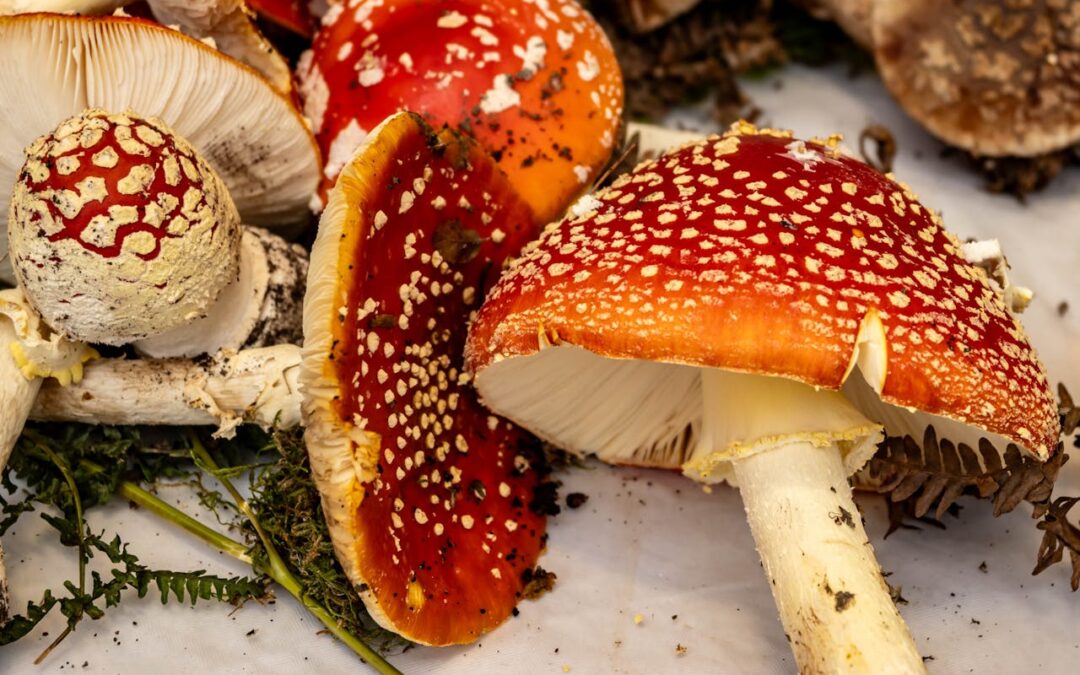
The Amanita Muscaria — the iconic red mushroom with white dots — is one of the most recognizable fungi in the world. It appears in stories like Alice in Wonderland, in video games such as Super Mario, and even as the familiar ???? emoji.
Yet beyond its playful appearance lies a deep and ancient legacy. For centuries, this mushroom has been revered as a sacred medicine in Siberia and parts of Europe, where it was used to support sleep, ease physical discomfort, and open the door to expanded states of awareness within shamanic traditions.
Today, Amanita Muscaria is experiencing a powerful renaissance, drawing renewed attention from both scientific research and conscious wellness practices, including thoughtful microdosing.
Is Amanita Muscaria really dangerous? Unpacking two common myths
Despite its long history, Amanita Muscaria is still surrounded by confusion and fear. Two misunderstandings are especially widespread.
First, many people assume it is deadly because it belongs to the Amanita family, which includes some of the most toxic mushrooms in the world. However, Amanita Muscaria does not contain amatoxins, the compounds responsible for most fatal mushroom poisonings.
A 2006 report from the North American Mycological Association, based on more than 30 years of mushroom poisoning records, documented only one death associated with Amanita Muscaria. Importantly, this was not caused by the mushroom itself, but by hypothermia that occurred after its consumption.
Second, although Amanita Muscaria is psychoactive, it does not work like psilocybin mushrooms. Its effects are primarily shaped by three compounds: ibotenic acid, muscimol, and muscarine. As a result, the experience feels distinctly different, both in the body and in the mind.
How Amanita Muscaria affects the body
Ibotenic acid acts on the nervous system by mimicking glutamate, which can lead to increased alertness, energy, and subtle perceptual shifts.
Muscimol, in contrast, mimics the neurotransmitter GABA, which is associated with relaxation and rest. This is why Amanita Muscaria is often linked to a sense of calm, deeper sleep, and dreamlike states. Ibotenic acid can be transformed into muscimol through controlled drying or fermentation.
Muscarine can be harmful, but it degrades when the mushroom is properly dried. For this reason, Amanita Muscaria should never be consumed fresh.
The overall effects depend on preparation, drying method, and dosage. In higher amounts, ibotenic acid may cause nausea or overstimulation, while muscimol can result in excessive sedation. This is why many people choose to work with microdoses instead.
Microdosing with Amanita Muscaria: reported benefits
In the book Microdosing with Amanita Muscaria (2022), Baba Masha compiled results from a large online survey. Among participants experiencing fatigue and depression, 87% reported noticeable improvements, 10% reported no change, and 3% experienced negative effects.
Commonly reported benefits included:
-
increased energy and vitality
-
greater creativity and mental clarity
-
improved mood
-
reduced bodily pain
-
better sleep quality and more vivid dreams
Some of these effects resemble those associated with microdosing psilocybin.
However, the last two — pain reduction and improved sleep — appear to be particularly characteristic of Amanita Muscaria.
Microdosing protocol and optimal dose
Microdosing with Amanita Muscaria tends to be most effective when approached with a clear protocol. It is not simply about “taking a little,” but about paying close attention to how the body and mind respond over time.
Following the approach outlined by Baba Masha, many people take a microdose daily for three weeks, followed by a one-week pause. This cycle allows gradual shifts in mood, energy, and sleep to unfold naturally, while reducing the risk of habituation.
Within this framework, finding your “sweet spot” is essential — meaning the smallest dose that brings a sense of calm and clarity without producing noticeable perceptual effects. This optimal dose is highly individual and may require gentle adjustments over time, but it commonly falls between 0.3 grams and 2 grams of dried powder.
Working with clear intention, keeping a reflective journal of your experiences, and having professional guidance can greatly enhance both safety and the meaningful integration of the effects into everyday life.
The contemporary renaissance of Amanita Muscaria
Interest in Amanita Muscaria is steadily growing. A key milestone was the Amanita Online Congress 2025, the first international conference dedicated to this mushroom. I joined leading voices in sharing knowledge about its scientific foundations, traditional uses, practical applications, safeguarding, and integration. I also shared my personal experience: Amanita helped me step away from Dormidina, which I had taken for years to sleep, and supported me in reconnecting with a more natural and restorative rest.
Academic research is also expanding. Psychologist Nora Mamblona Fischer from King’s College London is currently exploring the therapeutic potential of low doses of Amanita Muscaria through qualitative testimonies. More clinical studies are still needed, but the field is clearly moving forward.
legal status of Amanita Muscaria
In the Netherlands, Amanita Muscaria is illegal. In Spain, Portugal, Belgium, Germany, and the United Kingdom it is not classified as a controlled substance, although specific regulations apply in each country.
Where is Amanita Muscaria moving next?
It is possible that Amanita Muscaria may follow a path similar to psilocybin , greater visibility, more scientific research, and, over time, legal changes. This is likely to be a gradual process, but a steady one.
Like a strong tree, this movement needs time to grow. Yet when it does, it can offer lasting benefits to many people.
Want to learn more?
If you feel called to explore Amanita Muscaria, you’re welcome to reach out to me. I can share information, guidance, and resources to support you on this journey.
Recent Comments